If you’ve ever been part of a contract negotiation, you know how painful it can be. Redlines fly back and forth. Clauses are argued, re-argued, and re-worded. Weeks drag into months. Everyone loses time and money.
But imagine a world where most of that negotiation never hits your inbox. Instead, AI agents handle the back-and-forth automatically, and lawyers only step in when something really needs a human touch. That’s where we’re heading, thanks to a new standard called the Agent-to-Agent (A2A) protocol.
What Is Agent-to-Agent Protocol?
The A2A protocol is a new way for AI agents to talk to each other. Think of it like a universal handshake that lets two very different systems connect, exchange ideas, and agree on a result.
Instead of two humans sending redlines in Word docs, two software agents negotiate directly. They swap clause proposals, compare options, and settle on language, all within seconds.
Escalation-First Contracting: How It Works
Here’s the big shift: in this vision, lawyers don’t deploy “law firm agents” to negotiate on their behalf. They don’t need to.
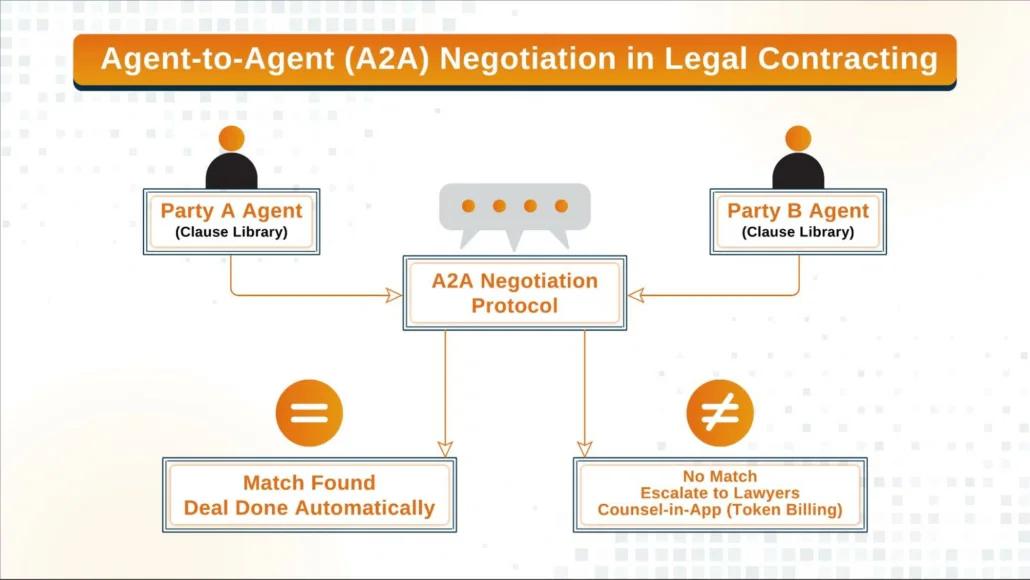
- Each party shows up with a library of pre-approved alternative clauses.
- The agents compare those alternatives. If they find a match, the deal moves forward instantly.
- If no match exists, the clause gets escalated. That’s when the lawyers are brought in.
The lawyer’s AI acts like a monitor. It watches the negotiations, keeps the lawyer updated, and raises a flag when something can’t be resolved automatically.
And here’s the kicker: when counsel does get involved, it happens right in the app. They draft or review new language, and instead of billing by the hour, they’re paid based on token consumption, basically, how much work the system needed to process the new text.
Real-World Examples
So what does this look like in practice? Let’s take a few common sticking points:
- Limitation of Liability Party A: “Liability capped at 12 months of fees.” Party B: “Liability capped at 12 months of fees.” ✅ Perfect match. Done.
- Arbitration vs. Litigation Party A: “Disputes resolved through arbitration.” Party B: “Arbitration with injunctive relief.” ✅ Overlap found. Agents agree.
- Indemnification Party A: “Mutual indemnification for third-party claims.” Party B: “Mutual indemnification for third-party claims.” ✅ Done instantly.
When no overlap exists, that’s when escalation kicks in.
Read more about MSP Vendor Liability.
[Table content: How A2A Actually Works Agent Cards Digital “business cards” that advertise what each agent can do, where it lives, and what rules it plays by. Task Lifecycle Every negotiation is a “task” with stages …]
Why This Matters
This model flips the script on how contracts get done:
- Speed → Most deals close without waiting weeks for redlines.
- Consistency → Alternatives all come from vetted libraries.
- Lower Costs → Lawyers only bill for escalations.
- Scalability → A single lawyer can supervise hundreds of deals at once.
Challenges to Solve
This isn’t magic. Real challenges remain:
- Clause libraries must be comprehensive and updated.
- Agents need semantic alignment to avoid mismatched interpretations.
- Escalations must be transparent and auditable.
- Law firms must adapt to new billing models (tokens, not hours).
Read more about MSP Contract Mistakes.
The Big Picture
We don’t need lawyers chasing every comma in a contract. We need them where they add the most value: solving complex problems, weighing risks, and giving strategic advice.
By letting agents handle the routine and escalating only the tough calls, we can move past the redline wars and into a faster, smarter future of contracting.
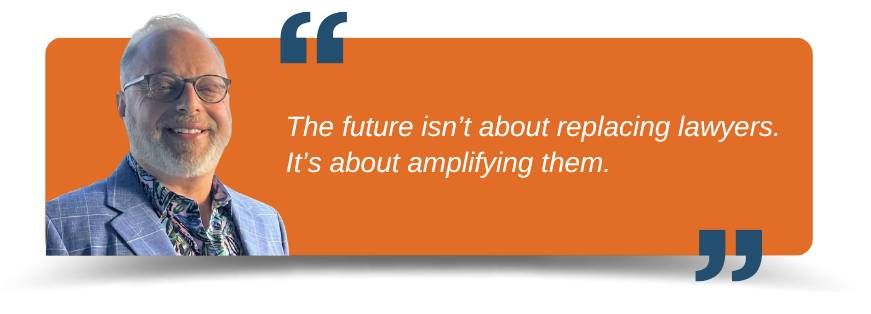
The future isn’t about replacing lawyers. It’s about amplifying them.
Glossary of Terms
- Agent Card → Digital ID card that tells other agents what an AI can do.
- Task Lifecycle → Step-by-step flow for AI contract negotiation.
- Message Parts → Data exchanged: text, files, structured info.
- JSON-RPC → A lightweight way to send commands between systems.
- SSE (Server-Sent Events) → Streams real-time updates.
- Token Consumption → A way of billing based on AI processing power used.
This article is general information, not legal advice, and does not create an attorney-client relationship with Scott & Scott, LLP. Outcomes depend on each client's facts; prior results do not guarantee a similar outcome.

Rob Scott
CEO & Co-Founder, Attorney
Attorney with 25+ years of MSP legal experience. Co-Founder of Scott & Scott, LLP and Monjur. Has overseen contracting for 1,000+ MSPs.
Rob Scott is an attorney with more than 25 years of experience in MSP and technology law, and the co-founder of both Scott & Scott, LLP and Monjur. He has overseen customer contracting for more than 1,000 managed service providers and built Monjur to bring attorney-supervised contract intelligence to the MSP industry.
Licensed in Texas since 1999, Rob earned his J.D. from the Maurice A. Deane School of Law at Hofstra University and his B.A. in Economics and Philosophy from Austin College. His practice focuses on software licensing, software audit defense, data privacy, and vendor risk, representing MSPs and enterprise clients in transactions and disputes with major software publishers.