

How Monjur Uses Attorney-Supervised Contract Intelligence to Automate Vendor ContractingMapping vendor paper to clause libraries, risk scores, and actionable insights.
Vendor contracting has become one of the most complex challenges for modern procurement and legal teams. The challenge extends beyond sheer numbers. It’s the complexity of applying internal standards consistently across vendor agreements that vary by structure, language, and risk profile. Manual review doesn’t scale. Generic AI lacks context. Legal teams stay stuck doing mechanical comparisons instead of focused legal judgment.
But understanding why this problem persists requires examining the specific failures that make vendor contracting so resistant to automation.
The Procurement Problem
Corporate procurement teams face a high volume of vendor contracts, MSAs, DPAs, NDAs, SLAs, and a dozen attachments for every engagement. Each document introduces new risks, obligations, and inconsistencies with company standards.
Every large company knows this pain. Procurement and legal teams have tested dozens of tools promising to “automate” vendor review, yet nearly all of them fail once they encounter real-world complexity.
One global enterprise GC told us they tested 27 different AI contract tools, and none worked reliably.
The primary reasons are outlined below.
Organizations don’t talk about Version Control nightmares; the constant evolution of terms, regulatory requirements, and vendor relationships creates an administrative burden that slows entire legal departments.
Why Vendor Contracting Is So Hard for AI
Today’s vendor ecosystem is an interconnected web of dependencies. Vendor risk management requires contract review and an understanding of how third-party providers create operational exposure.
1. Unstructured and Inconsistent Inputs
Vendor contracts don’t follow a single structure. Each supplier uses different numbering, section titles, and clause ordering.
Even state-of-the-art NLP models stumble when there’s no predictable pattern to follow.
2. Clause Fragmentation and Variation
The same concept, indemnity, limitation of liability, termination for convenience, might appear under entirely different headings or split across multiple sections.
AI sees these as different ideas when, in legal reality, they’re the same risk.
3. Context-Dependent Risk
Whether a clause is acceptable depends on the client’s role.
A limitation of liability might be fine for a marketing vendor but unacceptable for a data processor.
Generic AI models can’t adapt to company-specific risk profiles.
4. Interdependent Clauses
Legal risk rarely lives in isolation.
The indemnity clause depends on the liability cap; data protection ties back to confidentiality.
Traditional AI reads each clause in a vacuum, which breaks cross-clause logic.
5. Dynamic Legal Policies
Corporate standards evolve constantly: new risk thresholds, new fallback clauses, new regulatory requirements.
Static AI models quickly become outdated and can’t retrain fast enough to stay aligned.
6. Lack of Human Feedback Loops
Legal review requires judgment.
AI tools that don’t learn from attorney feedback simply repeat the same mistakes; they never truly “understand” the organization’s risk posture.
That’s why vendor contracting remains one of the most complex applications of applied legal AI.
Effective review depends on risk, policy, and context.
How Monjur’s Attorney-Supervised Intelligence Solves It
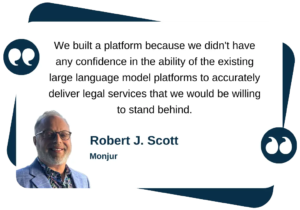 Monjur, powered by Pilot, is designed to handle this exact challenge through attorney-supervised contract intelligence.
They combine LLM-driven clause intelligence with attorney-supervised learning loops. This allows legal teams to automate vendor contract analysis without losing control.
Instead of software attempting to replace legal judgment, it is a managed service that extends attorney capacity under supervision. This approach ensures continuous evolution. It stays aligned with your organization’s actual risk posture and negotiation history.
All outputs are reviewed, approved, or rejected by a supervising attorney before becoming enforceable or reusable.
A Legal Managed Service, Not Just Software
 Each client gets their own contract knowledgebase (KB), a private library containing:
- Their standard clauses and preferred structure
- Pre-approved alternates and fallback options
- Custom risk scoring models and thresholds
- Jurisdictional and business-specific nuances
Monjur uses this library to map, score, and classify incoming vendor papers. Attorneys remain in the loop for validation and continuous learning.
This private KB architecture captures your organization’s “legal DNA.” It reflects how you negotiate, what you tolerate, and where you draw the line. The KB preserves the context and reasoning behind every decision. This transforms vendor contracting from a repetitive burden into structured, continuously improving legal intelligence.
How the Process Works
It contains 5 steps.
Step 1: Contract Intake
The procurement or legal team uploads a vendor agreement, such as an MSA, DPA, or NDA, into Monjur.
Step 2: Automated Clause Mapping
Monjur parses and classifies each clause, comparing it to the client’s clause library.
- Clauses with matches are automatically validated and risk-scored.
- Clauses without matches are flagged for attorney review.
This mapping process addresses a core challenge: clause fragmentation. The agent’s intelligence layer recognizes these variations. This prevents a common pitfall with AI systems. Traditional AI often misses identical clauses because they use different terminology or structural placement.
Step 3: LLM-Generated Alternatives
For unmapped clauses, the Procurement Agent’s LLM layer generates alternate options. These options are drawn from Monjur’s clause intelligence system.
The supervising attorney reviews the vendor clause. They check suggested alternatives. They edit as needed. Then they approve the final version.
Once approved, the new variant is added to the client’s private KB. This expands its intelligence for next time.
Step 4: Attorney-Supervised Learning Loop
Each review captures how a specific organization interprets vendor language within its own risk thresholds and policies. Approved decisions are incorporated into the client’s knowledge base, improving first-pass mapping on repeat vendor forms.
Attorney-defined thresholds and escalation rules ensure that new or uncertain language continues to route to human review.
This ongoing loop increases consistency and efficiency over time while keeping legal judgment firmly with attorneys.
Step 5: Risk Scoring and Reporting
Every clause, matched or new, is risk-scored using both the client’s defined thresholds and Monjur’s legal scoring logic.
Results are summarized into clear, role-specific dashboards for:
- Procurement: Which vendors deviate from standards?
- Legal: Which clauses need human review?
- Finance: Risk-weighted exposure by spend or contract category.
- Business Units: Plain-English summaries of vendor obligations and risk posture.
These role-specific views address a persistent challenge in vendor management. Different stakeholders need different information. But traditional contract repositories force everyone to sift through the same dense legal language.
Operational Impact: Structured Legal Intelligence for Procurement
I was able to respond back within 45 minutes with clear redline options and risk explanations.
– Todd Swaney, COO at Centre Technologies
With Monjur’s attorney-supervised Contract Intelligence, vendor contracting finally becomes predictable, measurable, and scalable.
- Incoming vendor paper is automatically mapped to your standards.
- Deviations are scored and routed for review.
- Attorneys focus on high-value judgment calls, not mechanical comparisons.
- Every approved clause enriches your legal knowledge base for next time.
Organizations see faster onboarding, lower legal costs, and measurable risk visibility across their entire supplier network.
The Broader Vision
Vendor contracting is about building consistency over time. How an organization evaluates risk, applies standards, and makes legal decisions is repeatable. Every company develops its own legal posture through experience, precedent, and attorney judgment.
Monjur captures that institutional knowledge through attorney-supervised Contract Intelligence. Vendor agreements are reviewed against approved standards, attorney decisions are validated and recorded, and outcomes are reflected in the organization’s Legal Knowledge Base. Over time, this improves consistency in vendor review while ensuring legal judgment remains with attorneys.
When combined with Monjur’s support for customer contracting, renewals, and collections workflows, organizations operate within a single, attorney-supervised contract ecosystem. Legal standards stay current, escalation paths remain clear, and contract processes are no longer fragmented across teams or tools.
With Monjur, legal is managed for you, structured, attorney-supervised, and designed to scale without increasing legal burden.
Disclaimer: This content is for educational purposes only and reflects Monjur’s attorney-supervised workflows. All legal outputs are subject to attorney review.