
Clients don’t just need legal support from 9 to 5. Questions about contracts, compliance, and risk can come up at midnight, over the weekend, or in the middle of a deal cycle. Traditionally, law firms haven’t been able to meet that demand, until now.
By training AI assistants to deliver round-the-clock legal support, we can give clients fast, reliable answers while keeping lawyers in control.
How We Trained an AI Legal Assistant
When we set out to build our AI legal assistant, we didn’t just throw it into the wild. We trained it with the same discipline you’d expect from a junior associate:
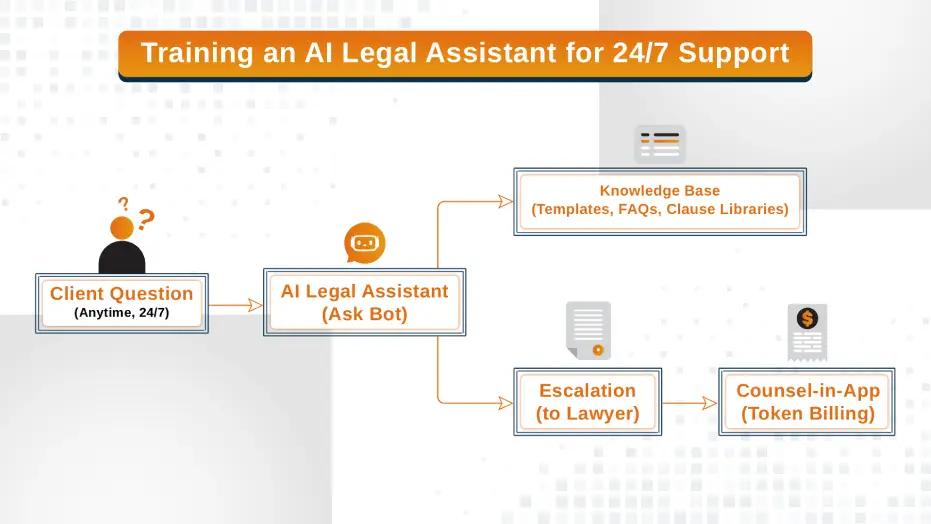
- Start with a Knowledge Base: We loaded the system with the firm’s existing templates, FAQs, and clause libraries. This gave the AI a solid foundation of “house rules.”
- Teach Escalation: Just like a first-year lawyer, the AI doesn’t guess. If it can’t find an answer in its knowledge base, it escalates. That escalation could mean surfacing the issue to counsel, asking the client for more detail, or flagging that a human needs to weigh in.
- Add Feedback Loops: Every time the AI answered a question or drafted language, lawyers reviewed it. We gave corrections, just like we would in training an associate. Over time, the assistant got sharper and more reliable.
- Integrate with Tools: The assistant wasn’t just a chatbot, it connected with our CRM, contract templates, and scheduling systems. That meant it could answer questions and take action, like pulling up the right clause or sending a scheduling link.
The Building Blocks of a Legal AI Assistant
Knowledge Base Start with your best templates, FAQs, and policies. Escalation Rules Teach the AI when to stop and hand off to a lawyer. Feedback Loops Build continuous learning into the system. System Integrations Connect to CRM, document management, and scheduling so the AI can act, not just talk.
Read more about AI Contract Intelligence.
The Benefits
The result? Clients can ask legal questions anytime, anywhere, and get an answer.
- 24/7 Availability: No waiting until Monday morning.
- Consistency: The AI never forgets the firm’s standard positions.
- Efficiency: Routine questions and tasks get handled instantly.
- Scalability: One lawyer can supervise what feels like an army of associates.
Real-World Examples
Here’s what 24/7 AI legal support looks like in action:
- A client working on a Sunday night asks: “What’s our fallback on indemnification?” The AI pulls the approved clause from the library and explains it.
- A sales rep at 10 p.m. wonders: “Do we have a template NDA for vendors?” The AI delivers the right document instantly.
- A contract negotiation agent escalates an unresolved clause at 2 a.m. The AI logs it and alerts counsel to review in the morning.
Challenges We Faced
Training an AI legal assistant isn’t without hurdles:
- Data Quality: Garbage in, garbage out. We had to carefully curate and clean the knowledge base.
- Oversight: AI can draft, but humans remain accountable. We built monitoring into every workflow.
- Ethics & Privacy: Client data must stay secure. We used strict authentication and audit trails.
- Change Management: Lawyers needed to trust the system. That took time, training, and transparency.
The Big Picture
The legal profession is changing. Clients expect more speed, more access, and more support, without ballooning costs.
By training legal AI assistants with legal knowledge, escalation rules, and human oversight, we can deliver a new kind of legal service: one that’s always on, always learning, and always aligned with the lawyer’s judgment.
This isn’t about replacing lawyers. It’s about making them more powerful, more scalable, and more valuable to the clients who depend on them.
Read more about AI Contract Negotiation.
Glossary of Terms
- Knowledge Base → A curated library of firm-approved templates, FAQs, and clauses.
- Escalation → The process of flagging issues the AI can’t handle to a human lawyer.
- Feedback Loop → Training cycles where human lawyers correct AI outputs to improve accuracy.
- Integration → Connecting the AI with existing systems like CRM or document management.
- 24/7 Legal Support → The end goal: clients always have a way to get legal help, even off-hours.
This article is general information, not legal advice, and does not create an attorney-client relationship with Scott & Scott, LLP. Outcomes depend on each client's facts; prior results do not guarantee a similar outcome.

Rob Scott
CEO & Co-Founder, Attorney
Attorney with 25+ years of MSP legal experience. Co-Founder of Scott & Scott, LLP and Monjur. Has overseen contracting for 1,000+ MSPs.
Rob Scott is an attorney with more than 25 years of experience in MSP and technology law, and the co-founder of both Scott & Scott, LLP and Monjur. He has overseen customer contracting for more than 1,000 managed service providers and built Monjur to bring attorney-supervised contract intelligence to the MSP industry.
Licensed in Texas since 1999, Rob earned his J.D. from the Maurice A. Deane School of Law at Hofstra University and his B.A. in Economics and Philosophy from Austin College. His practice focuses on software licensing, software audit defense, data privacy, and vendor risk, representing MSPs and enterprise clients in transactions and disputes with major software publishers.